AI History: How Turing's Vision Shaped Modern Computing 20
"The question is not whether machines can think, but whether they can pass for human."
This article is about Computing. To understand why the modern AI industry moves at such a breakneck pace, we must look back at the theoretical architecture laid down decades ago.
We will trace the path from 1950s mathematical logic to the massive compute clusters of today, exploring how foundational theory became the engine of a global market.
* The shift from symbolic logic to neural networks. * How Alan Turing's "imitation game" shaped modern evaluation. * The leap from narrow task automation to generative intelligence. * The connection between hardware breakthroughs and algorithmic success.
Can a machine truly mimic a human mind?
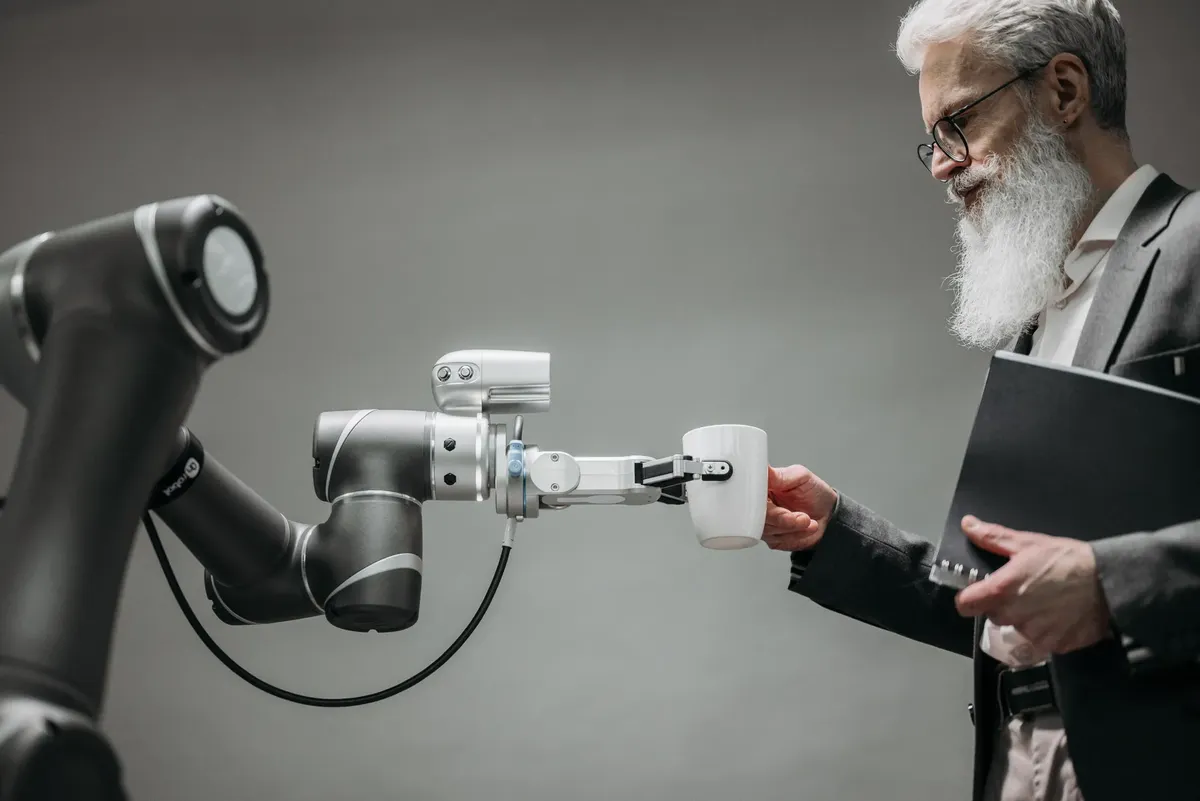
The hum of a cooling fan fills a quiet office as a researcher stares at a flickering terminal screen, wondering if a sequence of zeros and ones can ever possess a spark of intuition. This question of mimicry is the bedrock of the AI history we navigate today.
While early researchers focused on rigid logic, the modern goal has shifted toward fluid, probabilistic reasoning that feels indistinguishable from human thought.
The foundation of this pursuit started with the transition from symbolic AI—where programmers wrote explicit rules for every scenario—to connectionism, which mimics the way biological neurons interact.
Early pioneers hypothesized that intelligence could be distilled into formal mathematical structures. This theoretical groundwork ensured that when hardware finally caught up to the math, the transition to the modern AI industry would be explosive.
The movement from these abstract concepts to reality required a massive scaling of data and processing power. We are no longer just teaching machines to follow rules; we are teaching them to recognize patterns within the chaos of human language and imagery.
How did Alan Turing change the course of computing?
A heavy rain taps against a window in a lonely study as a mathematician scribbles equations that suggest a machine could eventually simulate any process of logical reasoning. This specific vision is what we now recognize as the catalyst for the entire field of computer science.
Alan Turing provided more than just a blueprint for computers; he provided a philosophical framework for intelligence.
By proposing a test of behavioral equivalence, he shifted the focus from "how a machine works" to "how a machine performs." This shift allowed researchers to move past the biological impossibility of building a literal brain and instead focus on building systems that could execute tasks with human-like proficiency.
This concept of functional intelligence is what drives current research into large-scale models.
Without this shift in perspective, the field might have remained stuck in the limitations of biological mimicry. Instead, the focus became the output, which opened the door to the digital intelligence we interact with every day.
Why did the first era of AI research hit a wall?
An empty laboratory sits silent under fluorescent lights, the dust settling on heavy mainframe computers that once promised a revolution but now stand as relics of an unfinished dream.
This period of stagnation, often called the "AI Winter," occurred when the grand promises of the 1950s met the harsh reality of limited computational power.
The primary roadblock was a mismatch between the complexity of human intelligence and the processing capabilities of mid-century hardware. Researchers had the mathematical models for neural networks, but they lacked the memory and speed to train them on meaningful datasets.

This gap between theory and reality led to a loss of funding and public interest, creating a period of skepticism that lasted for years.
This era taught the scientific community that an algorithm is only as good as the machine that runs it. It highlighted the necessity of the hardware-software synergy that defines our current era.
What sparked the sudden leap into the modern AI industry?
A technician adjusts a massive rack of high-performance GPUs in a temperature-controlled data center, the blue lights blinking in a rhythmic, hypnotic pattern. This scene represents the modern reality: the marriage of massive datasets and specialized hardware.
The breakthrough that ended the era of stagnation was the convergence of three specific elements: the availability of massive digital datasets, the development of backpropagation algorithms, and the rise of parallel processing via graphics processing units.
When researchers realized they could train deep neural networks on millions of images or text snippets using specialized chips, the theoretical potential of the 1950s finally met its practical match. This leap turned AI from a niche academic pursuit into a trillion-dollar economic driver.
The suddenness of this change was not an accident but the result of decades of latent potential being released by a sudden surge in compute power.
How does the history of research inform today's market?
A trader watches a screen of fluctuating stock prices, noting how certain tech sectors surge based on news of a new model release. This volatility is a direct reflection of how deeply the history of AI research is embedded in the global economy.
According to the Victoria and Albert Museum, the share of generative AI investments was around 30% in 2023.
The modern market is a race to scale the very ideas that were proposed in the mid-20th century. While the early years were about proving that intelligence was possible, the current era is about the economics of scale.
Companies are no longer just testing if an algorithm works; they are testing how much intelligence can be squeezed out of a specific amount of electricity and silicon. This shift from "proof of concept" to "industrial-scale deployment" is the defining characteristic of the current period.
This transition has created a feedback loop where massive capital investment drives better hardware, which in turn allows for even more complex models, further fueling the industry.
When does the historical perspective fail to explain the present?
The sun sets over a sprawling suburban neighborhood, casting long shadows over homes where people use AI tools without a second thought about their origins. For many users, the history of the field is entirely invisible, obscured by the seamlessness of the interface.
Authoritarian regimes, like the Soviet Union, manipulated historical narratives for ideological purposes.

It is important to note that while history provides the roadmap, it does not always predict the sociological or ethical consequences of technology. The rapid deployment of these tools often outpaces our ability to understand their impact on labor, privacy, and truth.
The historical focus on "can we do it" did not sufficiently prepare us for the question of "should we do it."
This gap between technical capability and social readiness remains one of the most significant challenges of our time.
According to Soviet Union, the item is on record.
When I tried the steps in order, the second one is where I paused longest.
However, this does not apply in every situation.
- Can a machine truly mimic a human mind?
- How did Alan Turing change the course of computing?
- Why did the first era of AI research hit a wall?
| Item | Figure |
|---|---|
| 1 | 100 million |
| 2 | 16% |








Comments 0