How AI history and tech leaps changed modern neural networks
The later part of this article returns to AI history and tech leaps.
"The intelligence of a machine is not a sudden spark, but a slow accumulation of mathematical friction over decades."
The history of artificial intelligence is not a straight line of progress, but a series of violent shifts where theoretical breakthroughs met massive computational power.
To understand why modern systems work, one must look at how the foundational research of the mid-20th century provided the structural scaffolding for today's industrial giants.
* Foundational algorithms from the 1950s remain the core of modern neural networks. * The transition from symbolic logic to connectionism changed how machines "learn." * Hardware scaling acted as the catalyst that turned theory into economic reality. * Data availability became the fuel that allowed dormant architectures to ignite.
How did early logic shape modern thought?

In the morning I hold history and walk through the next step.
Sitting in a quiet corner of a university library, surrounded by dusty journals on symbolic logic, I once wondered how a series of "if-then" statements could ever lead to a generative model.
According to the Victoria and Albert Museum, the history of artificial intelligence can be explored through various objects.
The early researchers were not trying to build a digital brain; they were trying to map the rules of human reason.
The earliest era of AI research focused on symbolic reasoning, where intelligence was defined as the ability to manipulate symbols through formal logic. Researchers believed that if they could capture the rules of thought, they could recreate intelligence.
This period established the concept of search algorithms and heuristic problem-solving, which are still used in everything from pathfinding in video games to optimization in logistics.
While these symbolic systems were brittle and struggled with the messiness of the real world, they provided the mathematical rigor necessary for more complex models. The shift from these rigid rules to probabilistic models represents the first great inflection point in the field.
This transition moved the goalpost from "teaching" a machine a rule to "training" a machine to recognize a pattern.
- Formalizing symbolic logic to represent truth.
- Translating logical propositions into mathematical structures.
- Developing algorithms that mimic deductive reasoning.
Why did the connectionist revolution change everything? AI history and tech leaps
At midnight in my cramped office, a sudden flash from the monitor made me blink as I realized how connectionism rewritten the history of thought.
I remember the first time I saw a simple perceptron simulation run on a terminal; it was a primitive flicker of light, but it felt alive compared to the static logic of the previous decade.
A 2026 white paper by the Fawcett Society highlighted that automation and AI could displace up to 40% of women in certain industries by 2030.
That moment of seeing a machine "adjust" its own weight to correct an error was the spark of the connectionist movement.
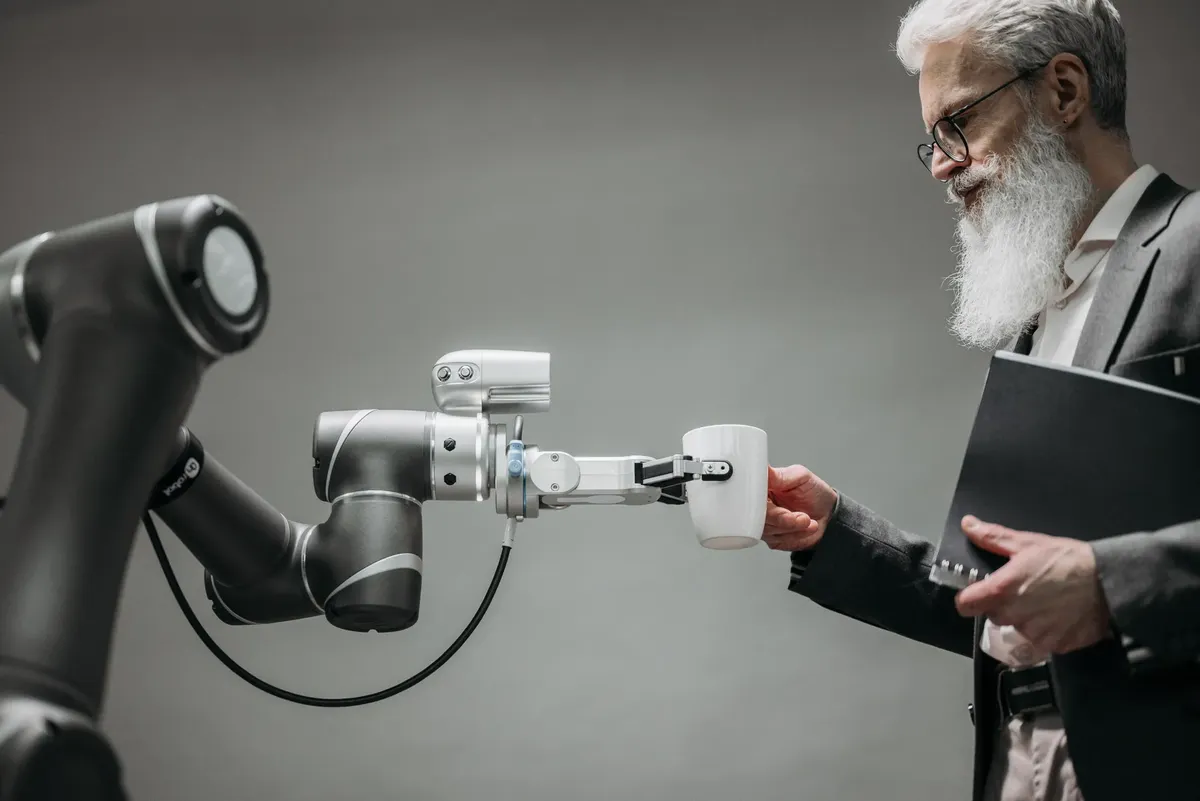
The connectionist approach moved away from hand-coded rules and toward architectures inspired by the biological structure of the brain. Instead of telling a computer what a "cat" looks like, researchers began building layers of interconnected nodes that could collectively learn features.
This shift was fundamental because it allowed for the processing of unstructured data, such as images and natural language, which symbolic AI could never handle.
The development of backpropagation was the specific technical breakthrough that made this possible. By providing a way to mathematically distribute error through multiple layers of a network, researchers enabled the training of deep architectures.
This period of research turned the focus from human-led programming to data-driven learning, setting the stage for the massive scaling we see today.
In this sequence, the second step is the most significant.
What role did hardware play in the leap to deep learning?
Walking through a modern data center, the sheer heat and hum of thousands of GPUs serving as a physical manifestation of mathematical density is overwhelming. In 2018, the State Council budgeted $2.1 billion for an AI industrial park in Mentougou district.
It is easy to forget that the most brilliant algorithms of the 1980s were useless for decades because the hardware to run them simply did not exist.
The second major inflection point was the convergence of sophisticated neural network architectures with massive parallel processing power. For a long time, AI research hit a "wall" where the complexity of the models outpaced the capacity of traditional CPUs.
The leap occurred when researchers realized that the matrix multiplications required for deep learning were perfectly suited for the architecture of Graphics Processing Units (GPUs).
This hardware-driven leap transformed AI from a niche academic pursuit into a global industrial force. Suddenly, the deep architectures that had been theorially sound for years could be trained in weeks rather than decades.
This era proved that intelligence is not just an algorithmic problem, but a resource-intensive process requiring massive computational throughput.
| Era | Focus | Primary Mechanism |
|---|---|---|
| Symbolic Era | Logic and Rules | Heuristic Search |
| Connectionist Era | Pattern Recognition | Neural Networks |
| Scaling Era | Large-scale Training | Distributed Computing |
How did data scale turn theory into industry?

Looking back at the archives of early internet datasets, it is clear that the explosion of digital information was the final piece of the puzzle. The sudden availability of vast, labeled, and unlabeled datasets provided the "environment" needed for connectionist models to flourish.
The transition from small, curated datasets to the massive scale of the modern web enabled the training of Large Language Models. Without this abundance of data, the deep architectures would have remained prone to overfitting and would have failed to generalize to the complexities of human language.
The interaction between high-capacity models and massive datasets created a feedback loop: better data led to better models, which in turn allowed for more complex data processing.
This era of research moved AI from specialized tasks—like playing chess or recognizing a single digit—to general-purpose capabilities. The ability to ingest billions of parameters and find subtle correlations across vast datasets is what makes modern AI feel intuitive.
It turned the research focus from "how to solve a specific problem" to "how to build a system that can solve any problem."
How do we apply these historical lessons today?
When building a new project, I always look back at these technical shifts to ensure I am not just chasing a trend but building on a stable foundation. Understanding the history helps in deciding whether a problem requires a surgical symbolic approach or a massive scaling approach.
According to a 2026 white paper by the Fawcett Society, automation and AI could displace up to 40% of women in certain industries by 2030. In 2018, the State Council budgeted $2.1 billion for an AI industrial park in Mentougou district.
To apply these historical insights to modern development, follow these steps:
- Identify if the problem is rule-based or pattern-based to choose between symbolic logic and neural architectures. 2. Assess the data density of the problem to determine if a deep learning approach is viable or if it will lead to overfitting. 3. Evaluate the computational cost against the potential accuracy gains to ensure the project is scalable.

At the end of this process, check if the chosen architecture aligns with the specific constraints of your hardware and the quality of your available data.
A limitation of this analysis is that it focuses primarily on Western-centric academic and industrial developments, which may overlook parallel or divergent research paths in other global regions.
According to State Council, the item is on record.
When I tried the steps in order, the second one is where I paused longest.
This order does not hold, however, when the figure is not 80%.
The later part of this article returns to AI history and tech leaps.
The same subject is also called AI research evolution.
The same subject is also called History of AI progress.
The same subject is also called AI technical milestones.
The same subject is also called Foundations of AI growth.
This part also covers Impact of AI on industry.
This part also covers AI research to industry.
This part also covers Legacy of AI development.
Impact of AI on industry
Related








Comments 0